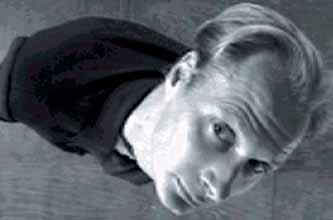
In the space ten black and white monitors are lined up in a row. The screens are blank, no action there. Then, as a visitor enters the space and approaches the monitors, a camera swoops down from the ceiling and stops just above of the visitor's head. He or she looks up startled and at that precise moment one of the monitors shows his or her face. The movements of people entering the space are being scanned within a small range around the cameras – ten of them, mounted on the ceiling – and the cameras react by pouncing upon the visitors like predatory spiders. When the visitors follow the row of monitors, they will see their faces appear on one monitor after the other, whereby the distance between the cameras and their heads becomes increasingly smaller. When they leave the camera's range, it retracts and disappears from view. Harco Haagsma's installations strike a balance between gruesome machines and friendly creatures. They think for themselves, react to persons who confront them, by means of sensors. At the same time they reflect the visitor's reactions to them. At first glance the installations do not look very spectacular. It s only in relation to the observer that they find their true form and acquire meaning. The principle of the surveillance camera plays an important role in this. Nowadays they are everywhere: in supermarkets, at petrol stations, cash dispensers and on motorways. Without really being aware of it we are being watched at several locations every day again and our movements are being recorded on videotape. In his work Haagsma attempts to expose the influence this has on our behaviour and our perception of reality. In a friendlier and more open way than in the case of 'Big Brother' the interaction between the viewer and the person being watched becomes the object of a physical presentation.
– Nathalie Zonnenberg
|
Harco Haagsma ° 1964, Vlaardingen (Netherlands)
Lives and works in Amsterdam (Netherlands)
|
|
 1 9 9 9