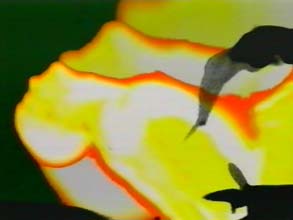
New media and dance are a hot item again. Dance software like Lifeforms and innovations such as motion capture have greatly expanded the art of contemporary dance. With now even Lara Croft from 'Tombraider' performing as a virtual dancer in a ballet, the borders between dance and media, between dancer and medium seem to be levelled for good. More than a century ago it was dancer Loie Fuller who incorporated new technology to give contemporary dance a new impulse. The freedom she had as a variety dancer, combined with her fascination for the new possibilities offered by (electrical) lighting, enabled her to experiment with an extra visual dimension in her dance. No wonder she was soon a subject in early film. Her performance in 'The Serpentine Dancer' (1891) was the source of inspiration for 'Two Step', which falls back on a pas-de-deux between dancer and medium, Fuller and Film. Kuntzsch, however, bridges a century of development in media and in modern dance by contrasting Fuller's cinematic experiments with the digital experiments in contemporary dance. She not only creates an extra time dimension with a pas-de-deux between dancer and digital media, she also introduces a transmedial pas-de-deux between film and digital video. 'Two Step' begins as an abstract medial dance in the "scratch'n flicker" of the film. Random images of Fuller's serpentine dance loom up like a spectral presence. The images, damaged by the ravages of time, are soon confronted with a liquid, digital Golem. The digital image gradually 'tuned' the two performances to each other until they seemed to be meeting at the same level. In the end, the play of attraction and rejection ends as it began. Fuller's apparition disintegrates and leaves us with the dance of pixels in the digital noise.
– Geert-Jan Strengholt
|
Music: Andreas Hoge, Production: Koppfilm
Betina Kuntzsch ° 1963, Berlin (Germany)
Lives and works in Berlin (Germany)
|
|
 1 9 9 9