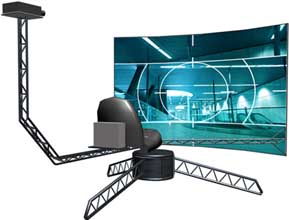
With the rise of new multi-media technologies modern society has become extremely susceptible to change. The increasing automation of our techniques of communication has led not only to individualization but has also to a general acceleration of life which has triggered a process of disorientation, 'delocalization' and existential deracination. "Today, we do not so much live in our homes as frequent our speed ; speed has become part of reality, and this obvious truth is so estranging that we no longer perceive the optical effect of speed and have taken to regarding the disordering effects of acceleration on perception as something normal." This quotation comes from Paul Virilio, the French theoretician and founder of 'dromology' (the science of speed) and it chimes well with the work of Marnix de Nijs. De Nijs's work portrays the modern human individual as a socially isolated and highly individuated being. In earlier work he examines the area of tension between private and public space, the world of the individual and the world of the other. Now however, with the rise of the computer media, we are in a position to act from a distance; 'real time' acquires primacy over space and surface, and physical barriers are no longer relevant. The notion that our personal lives are increasingly dominated by our relations with technology at the expense of direct relations with other individuals has inspired several interactive works. Technology abolishes the distance between the observer and the object of observation, with the consequence that our habitual ways of registering experience no longer provide us with a hold on events. Marnix de Nijs is interested in the perception of speed and has performed experiments with the influence of movement (rotation) on perception. In 'Open Head' (1998), for example , a motor-driven steel structure rotates a monitor displaying the artist's face in close-up. The tremendous speed of the rotating apparatus causes the image on the monitor to 'shift'. The installation probes our capacity to organize visual perception. 'Panoramic Acceleration' is an experience-machine in which De Nijs again manipulates the perception of speed. The installation embodies both the attractions of accelerating society and its critique. Here we are thrown back on our physical restrictions and limitations. The visitor sits in a cockpit on a motorized rotating arm and looks at the video on a screen rotating alongside it. A joystick enables the visitor to control the speed of his or her rotation. On the screen we see a mix of two identical video 'loops' recorded with a panning camera. We see video pictures of spaces in big-city surroundings: a traffic intersection, a metro station, sky-scrapers. They are all places of rapid mobility. The playing speed of one of the loops is linked to the rotation speed of the seat controlled by the visitor. The playing speed of the other visual source has been preset. In his/her attempts to gain control over the situation the visitor has no choice but to accept the tempo imposed by the machine. For only when the position and speed of the different image layers are precisely aligned can the visitor lessen the feeling of dizziness and achieve a sense of relative visual stability. The aim here is to achieve 'rest within movement', and it is De Nijs's subtle (as well as playful) way of hinting at how we could or should cope with dictated speed and its disorientating effects in our society.
– Marieke van Hal
|
Marnix de Nijs ° 1970, Arnhem (Netherlands)
Lives and works in Rotterdam (Netherlands)
|
|
 1 9 9 9